Rewriting the LinkedIn playbook for your organization
Rewriting the LinkedIn playbook for your organization
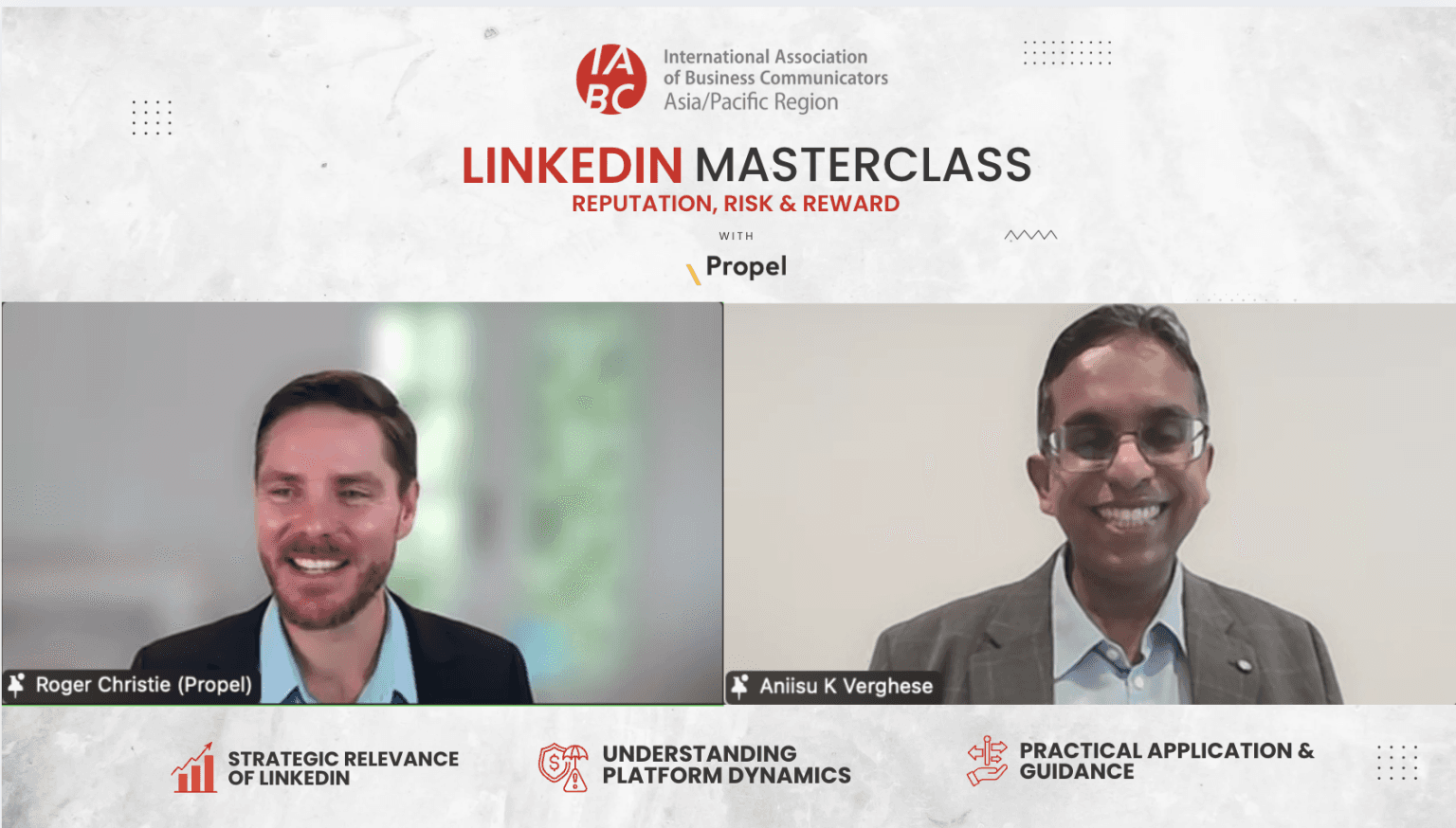
Following our recent IABC Asia-Pacific LinkedIn Masterclass alongside Roger Christie of Propel, one theme emerged consistently from participant questions – most communicators and organisations are fundamentally misunderstanding LinkedIn’s role in modern business strategy. After two decades of existence and over one billion users globally, LinkedIn remains the most underutilised and poorly executed platform in corporate communications.
Are you treating LinkedIn like a digital business card when it should be your organisation’s most powerful relationship-building engine? As a corporate communicator, how equipped are you to advise leaders on managing their digital reputation, especially on LinkedIn?
Interestingly, when we invited participants to tell us what came to their mind when they hear the word ‘Linkedin’, terms like networking, trust, reputation and bragging were most frequently highlighted – an indication of how practitioners perceive the platform’s current role and value.
The platform beckons
LinkedIn has transformed dramatically, yet most corporate communications teams are still operating with older playbooks. While your competitors debate whether to ‘do social media’, forward-thinking organisations are leveraging LinkedIn as their primary channel for sales enablement, talent attraction, investor relations, and stakeholder engagement.
The numbers tell a compelling story. H/Advisors Abernathy’s research reveals that 53 per cent of CEOs not on social media have inaccuracies in their online search profiles. Meanwhile, Brunswick Group data shows that when potential employees research companies, they visit the corporate website first, then immediately check the CEO’s LinkedIn profile. Your executive’s absent or outdated LinkedIn presence is actively damaging your reputation.
The need for authenticity
Here’s where most organisations get it wrong. They either avoid LinkedIn entirely or sanitise their leaders’ presence to the point of irrelevance. The middle ground of authentic, strategic engagement remains largely unexplored territory.
Research from the University of Florida reveals that moderate self-disclosure in CEO posts enhances perceptions of authenticity and favourability. The keyword is ‘moderate’. Leaders who overshare personal details or remain completely corporate both miss the mark. The sweet spot lies in strategic vulnerability that connects personal experience to business purpose.
Yet most corporate communications teams default to either extreme: complete risk aversion or unfiltered personal sharing. Neither approach builds the trust and credibility that modern stakeholders demand.
The quality vs quantity confusion
Perhaps the most damaging trend we observe is the race to post frequently without a strategic purpose. Among FTSE 100, CAC 40, and DAX 30 companies, FTI Communications research shows that 69 CEOs actively post on social media, averaging six posts per month. However, frequency means nothing without quality and strategic alignment.
Edelman’s B2B Thought Leadership Impact Report provides crucial context: B2B decision makers actively penalise low-quality thought leadership. They report that poor content damages their perception of organisations and leaders. Quality doesn’t just beat quantity. It’s the only metric that matters for senior stakeholder engagement.
This creates a particular challenge for corporate communications teams. The pressure to maintain regular posting schedules often conflicts with the time required to develop genuinely valuable content. Not just that, very rarely do they consider a commenting strategy, which is very influential in engaging the community and driving engagement. The result? Generic motivational posts, recycled industry platitudes, and corporate speak that alienate the very audience leaders need to influence.
Employee engagement and leader ownership
While external stakeholder engagement gets most attention, the internal implications of executive LinkedIn presence deserve equal focus. Brunswick research shows that employees prefer to work for CEOs who use digital and social media as part of their work, with approval rates reaching 82 per cent in Hong Kong and 63 per cent in Singapore.
More significantly, direct and transparent leadership communications emerge as leading factors for employee retention. Yet most organisations treat executive LinkedIn activity as purely external marketing rather than internal engagement strategy.
The multiplier effect is substantial. When employees see authentic leadership engagement online, they become more likely to participate in broader organisational communication efforts. This creates organic amplification that extends reach and impact far beyond paid marketing efforts.
LinkedIn and crisis communication
The expectation for executive digital communication during crises has become non-negotiable. Brunswick’s research reveals that 86 per cent of employees and 93 per cent of financial stakeholders expect CEOs to communicate on social platforms during difficult periods.
Yet most organisations lack frameworks for rapid, authentic crisis communication through executive channels. The result is either dangerous silence during critical moments or hastily crafted messages that lack strategic coordination with broader crisis management efforts.
LinkedIn’s professional context makes it the ideal platform for crisis communication, but only if leaders have established credibility and engagement patterns before crisis hits. You cannot build an authentic digital presence during turbulent times. It must be cultivated consistently during stable periods.
Measuring value
Most organisations that attempt LinkedIn strategy focus on vanity metrics such as likes, shares, and follower counts. These numbers provide limited insight into business impact and often mislead teams about actual performance.
Sophisticated measurement approaches track relationship quality, stakeholder engagement depth, qualified inbound opportunities, and network growth among target audiences. The goal shifts from broadcasting messages to building genuine relationships with key stakeholder groups.
This requires fundamental changes in how corporate communications teams think about success. Instead of campaign-style thinking, LinkedIn demands relationship-building approaches that generate long-term value rather than short-term visibility.
Governing right
Many organisations either over-govern LinkedIn activity to the point of paralysis or under-govern to the point of risk. Both approaches fail to maximise platform potential while managing legitimate concerns about disclosure, reputation, and crisis amplification.
Effective governance enables authentic engagement while managing risk. This requires clear frameworks for content approval, crisis escalation, disclosure of material information, and record retention that reflect LinkedIn’s unique characteristics: visibility, persistence, editability, and association.
The most successful approaches balance speed with quality, authenticity with risk management, and individual voice with organisational messaging.
Regional expectations and cultural context
Our Asia-Pacific focus reveals important regional variations in stakeholder expectations. In Hong Kong and Singapore, close to 90 per cent of respondents expect corporate leaders to communicate actively on digital platforms, compared to the global average of 56 per cent. This creates particular urgency for organisations operating in these markets.
Cultural nuances around leadership visibility, professional relationship-building, and business communication styles must inform LinkedIn strategies. Generic global approaches often fail to resonate with regional stakeholders who have specific expectations about executive accessibility and communication style.
The path forward
The evidence is overwhelming. LinkedIn represents a strategic imperative, not a nice-to-have marketing channel. Organisations that continue treating it as optional or secondary will find themselves increasingly disadvantaged in talent attraction, stakeholder engagement, and crisis communication.
The solution requires three fundamental shifts.
First, move from campaign thinking to relationship building.
Second, prioritise quality and authenticity over frequency and polish.
Third, integrate LinkedIn strategy with broader business objectives rather than treating it as an isolated marketing activity.
Corporate communications teams must evolve from gatekeepers to enablers, helping leaders develop authentic voices while managing legitimate risks. This requires new skills, different measurement approaches, and governance frameworks designed for relationship building rather than message control.
The organisations that master this transition will find that LinkedIn becomes their most powerful tool for building trust, attracting talent, and maintaining stakeholder relationships in an increasingly complex business environment.
What assumptions about LinkedIn is your organisation ready to challenge?
Aniisu K Verghese PhD is a change and communication practitioner, personal branding coach, author and speaker helping organisations and individuals communicate with clarity, connect employees to the purpose, improve reputations, and embrace change.
Roger Christie is Founder & Managing Director of digital reputation advisory firm Propel – a multi award-winning firm that helps leaders protect and enhance their digital reputation.
Following our recent IABC Asia-Pacific LinkedIn Masterclass alongside Roger Christie of Propel, one theme emerged consistently from participant questions – most communicators and organisations are fundamentally misunderstanding LinkedIn’s role in modern business strategy. After two decades of existence and over one billion users globally, LinkedIn remains the most underutilised and poorly executed platform in corporate communications.
Are you treating LinkedIn like a digital business card when it should be your organisation’s most powerful relationship-building engine? As a corporate communicator, how equipped are you to advise leaders on managing their digital reputation, especially on LinkedIn?
Interestingly, when we invited participants to tell us what came to their mind when they hear the word ‘Linkedin’, terms like networking, trust, reputation and bragging were most frequently highlighted – an indication of how practitioners perceive the platform’s current role and value.
The platform beckons
LinkedIn has transformed dramatically, yet most corporate communications teams are still operating with older playbooks. While your competitors debate whether to ‘do social media’, forward-thinking organisations are leveraging LinkedIn as their primary channel for sales enablement, talent attraction, investor relations, and stakeholder engagement.
The numbers tell a compelling story. H/Advisors Abernathy’s research reveals that 53 per cent of CEOs not on social media have inaccuracies in their online search profiles. Meanwhile, Brunswick Group data shows that when potential employees research companies, they visit the corporate website first, then immediately check the CEO’s LinkedIn profile. Your executive’s absent or outdated LinkedIn presence is actively damaging your reputation.
The need for authenticity
Here’s where most organisations get it wrong. They either avoid LinkedIn entirely or sanitise their leaders’ presence to the point of irrelevance. The middle ground of authentic, strategic engagement remains largely unexplored territory.
Research from the University of Florida reveals that moderate self-disclosure in CEO posts enhances perceptions of authenticity and favourability. The keyword is ‘moderate’. Leaders who overshare personal details or remain completely corporate both miss the mark. The sweet spot lies in strategic vulnerability that connects personal experience to business purpose.
Yet most corporate communications teams default to either extreme: complete risk aversion or unfiltered personal sharing. Neither approach builds the trust and credibility that modern stakeholders demand.
The quality vs quantity confusion
Perhaps the most damaging trend we observe is the race to post frequently without a strategic purpose. Among FTSE 100, CAC 40, and DAX 30 companies, FTI Communications research shows that 69 CEOs actively post on social media, averaging six posts per month. However, frequency means nothing without quality and strategic alignment.
Edelman’s B2B Thought Leadership Impact Report provides crucial context: B2B decision makers actively penalise low-quality thought leadership. They report that poor content damages their perception of organisations and leaders. Quality doesn’t just beat quantity. It’s the only metric that matters for senior stakeholder engagement.
This creates a particular challenge for corporate communications teams. The pressure to maintain regular posting schedules often conflicts with the time required to develop genuinely valuable content. Not just that, very rarely do they consider a commenting strategy, which is very influential in engaging the community and driving engagement. The result? Generic motivational posts, recycled industry platitudes, and corporate speak that alienate the very audience leaders need to influence.
Employee engagement and leader ownership
While external stakeholder engagement gets most attention, the internal implications of executive LinkedIn presence deserve equal focus. Brunswick research shows that employees prefer to work for CEOs who use digital and social media as part of their work, with approval rates reaching 82 per cent in Hong Kong and 63 per cent in Singapore.
More significantly, direct and transparent leadership communications emerge as leading factors for employee retention. Yet most organisations treat executive LinkedIn activity as purely external marketing rather than internal engagement strategy.
The multiplier effect is substantial. When employees see authentic leadership engagement online, they become more likely to participate in broader organisational communication efforts. This creates organic amplification that extends reach and impact far beyond paid marketing efforts.
LinkedIn and crisis communication
The expectation for executive digital communication during crises has become non-negotiable. Brunswick’s research reveals that 86 per cent of employees and 93 per cent of financial stakeholders expect CEOs to communicate on social platforms during difficult periods.
Yet most organisations lack frameworks for rapid, authentic crisis communication through executive channels. The result is either dangerous silence during critical moments or hastily crafted messages that lack strategic coordination with broader crisis management efforts.
LinkedIn’s professional context makes it the ideal platform for crisis communication, but only if leaders have established credibility and engagement patterns before crisis hits. You cannot build an authentic digital presence during turbulent times. It must be cultivated consistently during stable periods.
Measuring value
Most organisations that attempt LinkedIn strategy focus on vanity metrics such as likes, shares, and follower counts. These numbers provide limited insight into business impact and often mislead teams about actual performance.
Sophisticated measurement approaches track relationship quality, stakeholder engagement depth, qualified inbound opportunities, and network growth among target audiences. The goal shifts from broadcasting messages to building genuine relationships with key stakeholder groups.
This requires fundamental changes in how corporate communications teams think about success. Instead of campaign-style thinking, LinkedIn demands relationship-building approaches that generate long-term value rather than short-term visibility.
Governing right
Many organisations either over-govern LinkedIn activity to the point of paralysis or under-govern to the point of risk. Both approaches fail to maximise platform potential while managing legitimate concerns about disclosure, reputation, and crisis amplification.
Effective governance enables authentic engagement while managing risk. This requires clear frameworks for content approval, crisis escalation, disclosure of material information, and record retention that reflect LinkedIn’s unique characteristics: visibility, persistence, editability, and association.
The most successful approaches balance speed with quality, authenticity with risk management, and individual voice with organisational messaging.
Regional expectations and cultural context
Our Asia-Pacific focus reveals important regional variations in stakeholder expectations. In Hong Kong and Singapore, close to 90 per cent of respondents expect corporate leaders to communicate actively on digital platforms, compared to the global average of 56 per cent. This creates particular urgency for organisations operating in these markets.
Cultural nuances around leadership visibility, professional relationship-building, and business communication styles must inform LinkedIn strategies. Generic global approaches often fail to resonate with regional stakeholders who have specific expectations about executive accessibility and communication style.
The path forward
The evidence is overwhelming. LinkedIn represents a strategic imperative, not a nice-to-have marketing channel. Organisations that continue treating it as optional or secondary will find themselves increasingly disadvantaged in talent attraction, stakeholder engagement, and crisis communication.
The solution requires three fundamental shifts.
First, move from campaign thinking to relationship building.
Second, prioritise quality and authenticity over frequency and polish.
Third, integrate LinkedIn strategy with broader business objectives rather than treating it as an isolated marketing activity.
Corporate communications teams must evolve from gatekeepers to enablers, helping leaders develop authentic voices while managing legitimate risks. This requires new skills, different measurement approaches, and governance frameworks designed for relationship building rather than message control.
The organisations that master this transition will find that LinkedIn becomes their most powerful tool for building trust, attracting talent, and maintaining stakeholder relationships in an increasingly complex business environment.
What assumptions about LinkedIn is your organisation ready to challenge?
Aniisu K Verghese PhD is a change and communication practitioner, personal branding coach, author and speaker helping organisations and individuals communicate with clarity, connect employees to the purpose, improve reputations, and embrace change.
Roger Christie is Founder & Managing Director of digital reputation advisory firm Propel – a multi award-winning firm that helps leaders protect and enhance their digital reputation.
News
Written by

Roger Christie
NEVER MISS A THING!
Subscribe to stay in the loop with all things IABC APAC
Join the newsletter to receive the latest updates in your inbox.
News
Written by
Roger Christie
NEVER MISS A THING!
Subscribe to stay in the loop with all things IABC APAC
Join the newsletter to receive the latest updates in your inbox.



The International Association of Business Communicators (IABC) enables a global network of communicators working in diverse industries and disciplines to identify, share, and apply the world’s best communication practices. IABC is recognized as the professional association of choice for communicators who aspire to excel in their chosen fields.
We are part of the International Association of Business Communicators whose global headquarters is located at 330 North Wabash Avenue, Suite 2000 Chicago, Illinois 60611. (www.iabc.com)
The International Association of Business Communicators (IABC) enables a global network of communicators working in diverse industries and disciplines to identify, share, and apply the world’s best communication practices. IABC is recognized as the professional association of choice for communicators who aspire to excel in their chosen fields.
We are part of the International Association of Business Communicators whose global headquarters is located at 330 North Wabash Avenue, Suite 2000 Chicago, Illinois 60611. (www.iabc.com)
The International Association of Business Communicators (IABC) enables a global network of communicators working in diverse industries and disciplines to identify, share, and apply the world’s best communication practices. IABC is recognized as the professional association of choice for communicators who aspire to excel in their chosen fields.
We are part of the International Association of Business Communicators whose global headquarters is located at 330 North Wabash Avenue, Suite 2000 Chicago, Illinois 60611. (www.iabc.com)
Build community
Advance your career
Stay ahead of global trends
IABC connects communication professionals with the people and resources they need to drive business results and support their career.
© 2025 International Association of Business Communicators APAC. All rights reserved.
Build community
Advance your career
Stay ahead of global trends
IABC connects communication professionals with the people and resources they need to drive business results and support their career.
© 2025 International Association of Business Communicators APAC. All rights reserved.
Build community
Advance your career
Stay ahead of global trends
IABC connects communication professionals with the people and resources they need to drive business results and support their career.
© 2025 International Association of Business Communicators APAC. All rights reserved.